
Digitalization in Swiss Healthcare – A Look Back and Ahead
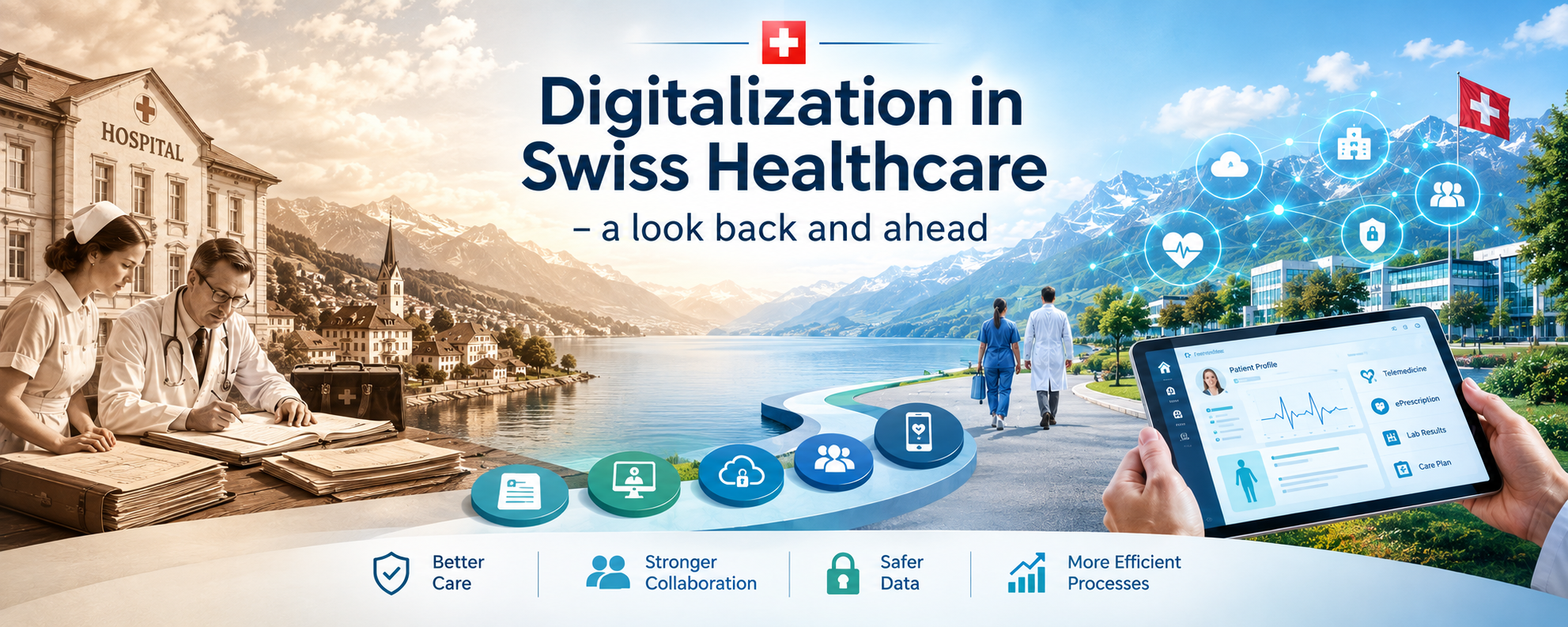
Since the end of 2005, I have been active in the Swiss eHealth environment in various positions and roles. I contributed to many of the systems and projects mentioned below. Swiss digital healthcare currently finds itself in a new phase of reorientation: the breakthrough of the electronic patient record (EPD) never happened, and its successor, the electronic health record (EGD), is now being prepared. The essential foundation for this, however, is the passage and entry into force of the new law. The DigiSanté program has been underway for a year, and pioneering decisions and concepts have already been approved – but the road to completion is still long, and a number of obstacles still need to be overcome.
Digitalization in Swiss Healthcare
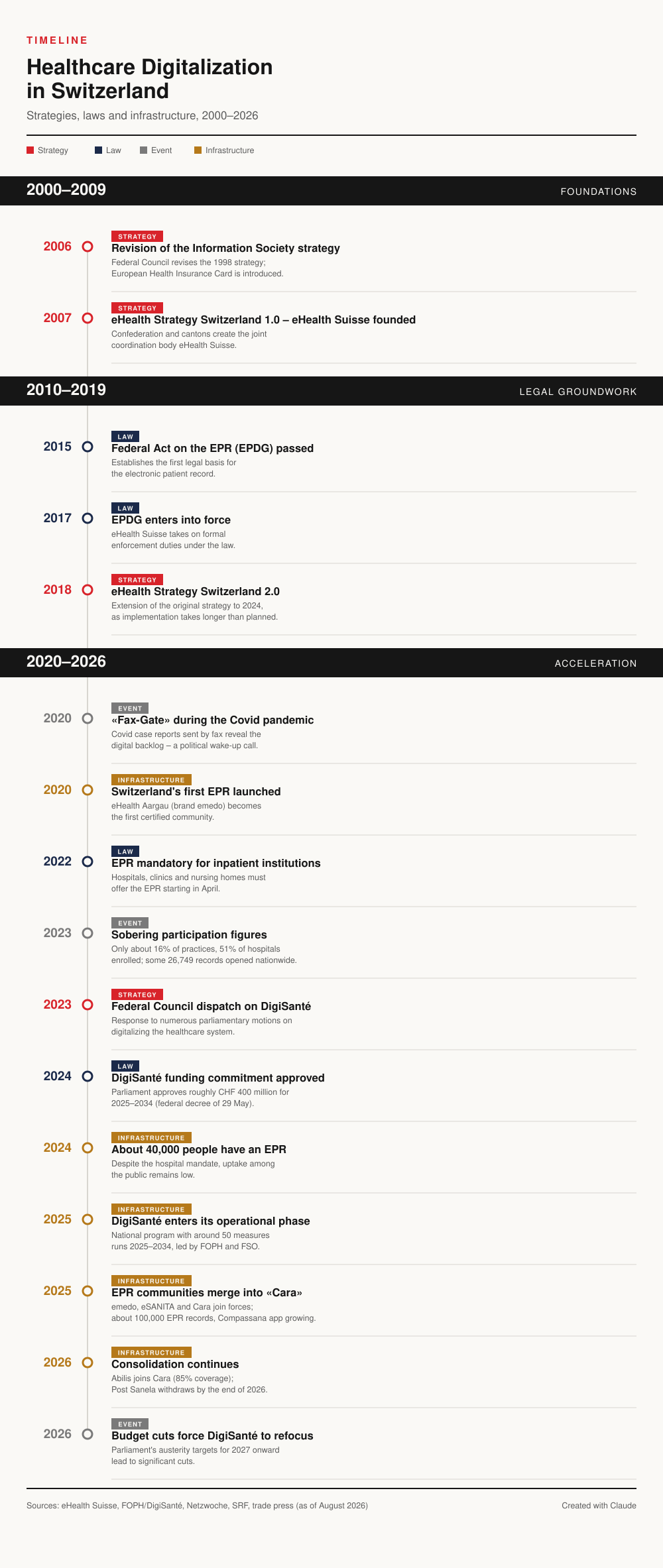
But let’s take it step by step.
Secure Communication
In the early years, I worked in the field of secure data transmission – the HIN client. Health data deserves particular protection. This begins already at the point of transmission, not just at storage. That is why HIN, now 30 years old, was founded. Since then it has operated a platform for secure data exchange, especially for protected email traffic, but also as a secure channel with authentication and authorization for various online services.
The HIN system was also used to electronically transmit physicians’ service billing data – using the XML standard of the Forum Datenaustausch – to the TrustX exchange and processing platform. Purely from a technical standpoint, these were very advanced methods of digital data exchange for their time – not proprietary, but based on uniformly defined formats and interfaces as a national standard. Here I want to emphasize that the digitalization of billing data exchange was implemented comparatively quickly, since it ultimately concerns making money, and billing in this format and structure is mandated. As soon as a use case becomes mandatory, it is also swiftly implemented in the systems. Things are different in the context of clinical data, since to this day no money can be made from it.
The Beginning of Online Systems
In the 2000s, people began using the WWW to run practice systems online, and were already thinking about data sharing. Ärztekasse began building a web-based medical record system at that time. The application was based on data security and encrypted storage, including access rights via cryptographic methods. Clinical data was stored as free text, but structured according to units defined by the SOAP schema. Codes from corresponding code systems were already partly in use, so this data can be described as semi-structured. Medication, allergy, and vaccination data were captured as structured elements from the outset; a medication plan with an interaction check was also already available.
The first digital exchange – the import of lab results – initially took place, as was common at the time, using proprietary formats. Early on, however, HL7® V2® messages were also added, which were stored with the respective patient and displayed accordingly in the interface.
Around the same time, Swisscom supported employee ideas that could then be implemented in projects. Among these was the idea of a secure patient record called Evita. The system was based on a high level of security: both patients and connected physicians stored their private keys – and, in the case of patients, also emergency-relevant data – on a credit-card-format USB card. The card had secure key and data storage, so the patient could always carry their data with them. The application itself was also located on this USB card and could be launched directly from it. The idea and the system were certainly about twenty years ahead of their time. However, the hardware token caused a number of technical problems: USB ports were often disabled in hospitals, and strict firewall rules led to communication problems between the app and the server. Because of the high security level, automatic data exchange with third-party systems without physical presence and an active application was not possible.
During the pilot phase, which was free for all participants, the system could be rolled out and operated, and valuable insights were gained. Unfortunately, shortly after transitioning to production it had to be discontinued in this form due to low interest. Instead, a pure online-light version with reduced functionality was introduced, which was then completely discontinued at the end of 2024 (swisscom-macht-gesundheitsplattform-evita-dicht).
Successful Standardized Data Exchange
In the 2010s, the online platform meineimpfungen.ch was built and put into operation using private funds, run by the foundation of the same name. The platform included an electronic patient record with a permission system through which patients could grant their doctors access. Patients, doctors, and the digitalization center could enter and manage vaccinations. A major advantage was the integrated vaccination check with its traffic-light system, which was highly valued by all users and, for some doctors, even led to its own business model – vaccination counseling.
The exchange format specified in Switzerland based on HL7® CDA® (CDA-CH-VACD) was used together with the IHE-XDS profile to enable automatic electronic exchange of vaccination data. At least two practice-system vendors integrated this standard-based exchange into their systems and rolled it out to their customers.
Unfortunately, this quite successful system had to be taken out of operation during the Corona pandemic in 2021 as a result of a campaign surrounding a security vulnerability. The more than 350,000 records were inaccessible to their owners for a time, but were then made available again by eHealth Aargau and could be transferred directly into an existing EPD.
Without this reputational damage, we would probably have an advanced electronic record today for data related to immunization and vaccination. The HL7® FHIR® standard, which emerged during this period, was already being discussed, and a FHIR API would likely be in successful use today for connecting primary systems.
A recently formed joint working group of HL7 Schweiz and openEHR Schweiz has taken up this topic, with the goal of further developing the “Digital Vaccination Record” showcase implemented at the GovTech Hackathon 2026 and evolving it into a productive service for the vaccination domain of SwissHDS.
The CDA-CH-VACD exchange format was adopted by ELGA in Austria as an “Electronic Vaccination Pass,” adapted to their needs, and has been successfully in use since the Corona pandemic.
In Switzerland, the fundamental decision was made in 2022 to migrate all CDA exchange formats to corresponding HL7® FHIR® formats.
Timeline: Founding of the standardisation organisation
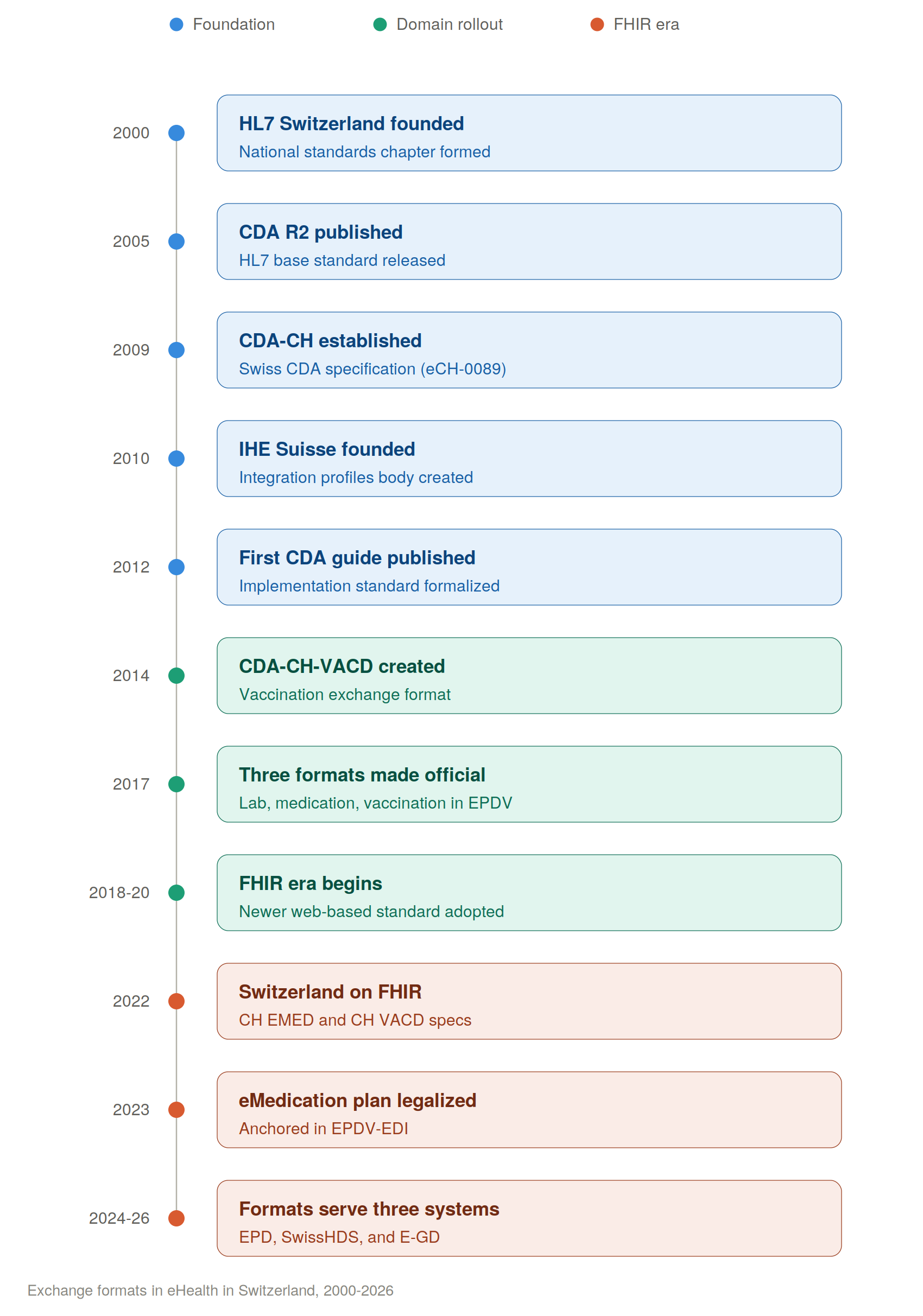
Exchange Format Available – Systems Not
The year 2020 was marked by the Corona pandemic, which became a genuine digitalization wake-up call for Switzerland. There were very many cases of illness and death, which is why a lockdown was even imposed to protect the healthcare system from collapse.
Since Corona was a notifiable disease, test results and findings had to be reported to the cantonal physician and the Federal Office of Public Health. A corresponding exchange format (CDA-CH-LRPH) based on the HL7-CDA standard (Clinical Document Architecture) had already been specified and published at that time. A pilot phase with several laboratories had started about half a year before the outbreak of the pandemic. On the authorities’ side, however, there were no efforts to build a corresponding system – not even once the pandemic took its course. Initially, forms had to be filled out by hand and transmitted by fax; later an Excel template was provided and the recorded data was transferred via CSV. It would have been an opportunity to develop, at one of the hackathons launched at the time, a solution to expand transmission via the exchange format that already existed.
Today, in 2026, we have finally reached that point: we now have an HL7® FHIR®-based exchange format, CH ELM, as well as a corresponding system with an endpoint through which laboratories must submit their findings (Ordinance on the Reporting of Observations of Communicable Diseases).
The EPD – The Patient’s Storage System
In 2007, the eHealth Strategy Switzerland 1.0 was published with the goal of using information and communication technologies to network the actors in the healthcare system, in order to make processes qualitatively better, safer, and more efficient. In the same year, the Confederation and the cantons concluded a framework agreement to create the coordination body “eHealth Suisse.” By the end of 2015, everyone in Switzerland was to be able to grant their healthcare professionals electronic access to treatment-relevant information.
In April 2017, the Federal Act on the Electronic Patient Record came into force – the starting signal for a new digital age. Technically, the system was built on international process definitions and standards (IHE profiles: PIXv3, PDQv3, XDS, ATNA, XUA) and supplemented with Swiss-specific elements (PPQ, CPI, ATC). The EPD was intended to function as a decentralized document storage system. The first community to put the system into operation and successfully complete certification was the core community eHealth Aargau (emedo). Six further communities followed, with systems from a total of four different vendors.
In 2017, the original 2007 strategy was extended through 2024 with “eHealth Strategy Switzerland 2.0,” since implementation took considerably longer than planned.Due to the dual voluntariness, the lack of acceptance, and the practically nonexistent connection of primary systems, the EPD never really gained traction. It was often referred to as a “PDF graveyard” – even though various exchange formats with highly structured data had indeed been defined and approved.
In the meantime, practically all (core) communities have merged and now jointly use the unified CARA platform. In this way, the market has regulated itself, and what was originally conceived as a decentralized system has developed into a centralized one that still meets the legal requirements.
Common Threads – Missing Sources
Commonalities emerge across practically all the systems described when it comes to data exchange: as long as documents (e.g., PDFs) are being exchanged, the primary systems involved can usually be integrated without major problems. As soon as structured data is involved, however, most primary systems reach their limits. They were designed primarily for administering patient data and billing services, not for structured capture of clinical data – so one is very quickly confronted with unstructured free text. Medications and vaccinations pose less of a problem here, since they are based on products whose information is available in a structured form in corresponding databases and has unique identifiers (GTIN), allowing them to be used as structured data. For all other data, beyond the free text, a transformation into coded elements is needed, with codes ideally drawn from uniform, ideally international coding systems such as SNOMED Clinical Terms® (SNOMED CT®) or LOINC (semantics).
With the rise of artificial intelligence (AI) and large language models (LLMs) for specific healthcare applications, the ability to extract structured datasets from text has improved massively – a genuinely important contribution to further digitalization. However, a qualified professional is still needed to verify and approve the data produced by AI. A very high priority must be given to security in this context, since health data deserves particular protection. Vendors face a strong obligation here to ensure this protection accordingly.
Vendors are therefore required to expand their systems so that they can also capture, store, and exchange clinical data in structured form. The logic and usability of the applications should support healthcare professionals in capturing data more easily.
Standardization Organizations
So that the standardization organizations active in healthcare can make themselves better heard and also gain a seat on federal bodies, seven organizations have joined together for closer collaboration and better information exchange under the name ehealthstandards.ch, and have published a memorandum on cooperation in the field of “digital health”. A representative appointed by them was able to gain a seat on the federal Data Management working group.
A brief overview of the seven organizations and their founding dates:
Timeline: Founding of the standardisation organisation
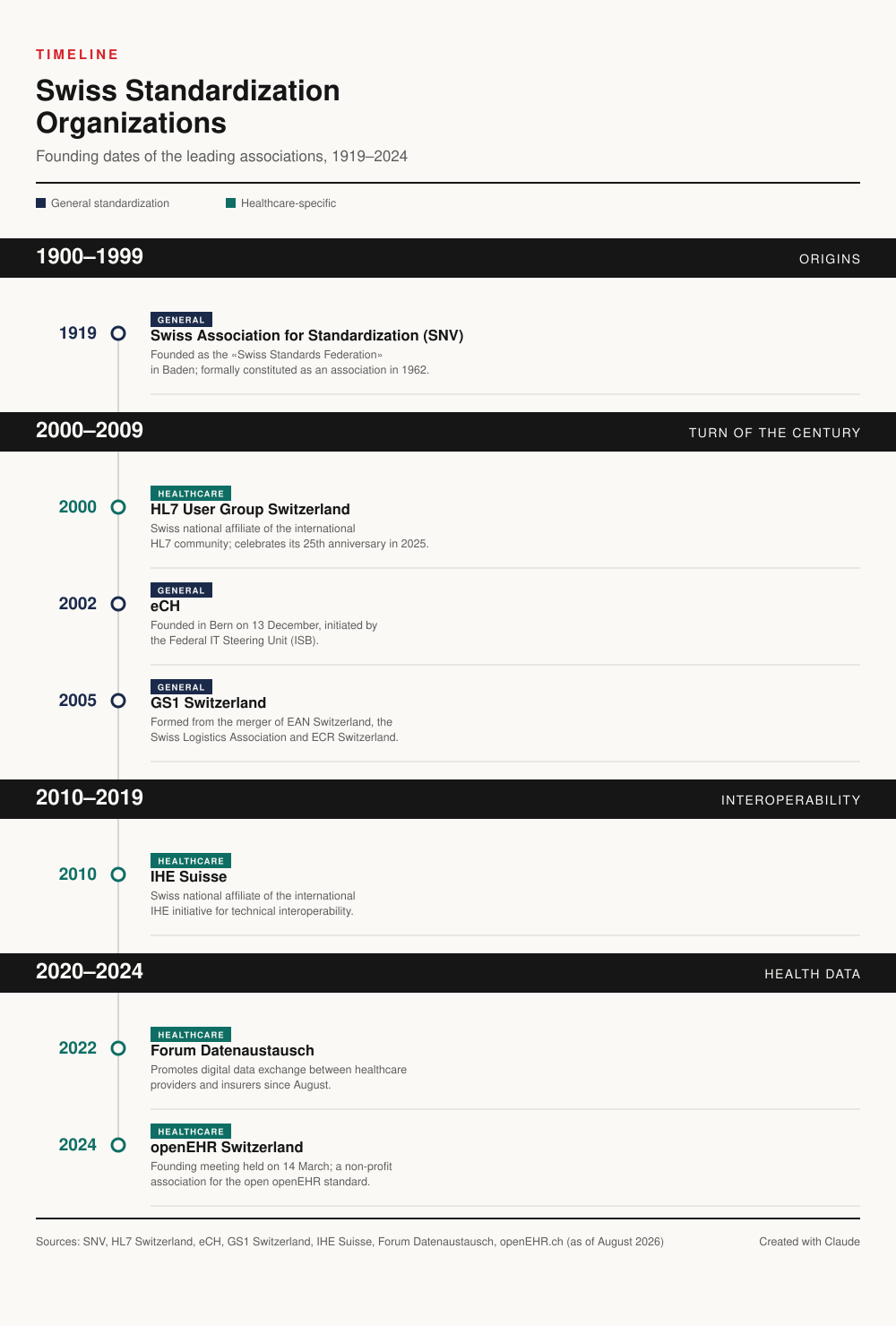
The Schweizerische Normen-Vereinigung (SNV) is among the older of these organizations and was founded on July 1, 1919, in Baden as the “Schweizerischer Normalien-Bund,” later renamed SNV. In 1962, it was formally constituted as an association. However, it does not operate exclusively in healthcare.
The HL7 User Group Switzerland was founded in 2000 as an affiliate of the international organization HL7 International. The HL7® v2® standard was the organization’s authoritative standard at the time and found widespread use over the years, particularly in the hospital setting, where it remains in widespread use today. Further standards such as HL7® v3®, HL7® CDA®, and HL7® FHIR® followed.
The Verein eCH was founded in 2002 on the initiative of the Federal IT Strategy Body, with the purpose of promoting eGovernment in Switzerland and developing norms and standards that facilitate electronic collaboration between authorities, as well as between authorities and private individuals, companies, and educational and research institutions.
GS1 Switzerland was formed in 2005 from the merger of the three associations EAN Switzerland, the Swiss Society for Logistics, and ECR Switzerland. The international GS1 organization itself is older (EAN originated in 1977).
IHE Suisse, the Swiss national organization of the international IHE initiative, was founded in 2010.
In August 2022, the Verein Forum Datenaustausch was founded, promoting digital data exchange between healthcare providers and payers in administrative healthcare. It took over the standards of a previously informal working group / simple partnership that had also already been founded in the 2000s.
The founding meeting of openEHR Switzerland took place on March 14, 2024 – as a nonprofit association for promoting the open openEHR standard for health data.
The EGD – A Fresh Start?
With the planned legal revision, the EPD has also received a new name: electronic health record (EGD). This is intended to create the foundation for enabling electronic data exchange related to a person’s health.
This does not mean, however, that the EPD will now be permanently abolished – rather, it is to be transferred into the new system. The dossiers that already exist, along with their data, are meant to be preserved and serve as the foundation. New functionalities and formats can then be added on top of this – provided the adapted legal basis allows it – with expanded capabilities that bring the system the necessary added value.
DigiSanté and the Swiss Health Data Space
DigiSanté is the national program for promoting digital transformation in healthcare. It started in early 2025 and runs until 2034, with the goal of increasing treatment quality, patient safety, and the efficiency of the healthcare system.
Establishing standards for the structure and content of data is intended to ensure interoperability and the once-only principle as consistently as possible. On this basis, system vendors should be able to orient themselves, giving them planning and investment security.
In this context, the Swiss Health Data Space (SwissHDS) project was launched. SwissHDS defines a virtual space in which health data can be exchanged securely, in compliance with the law, fully automated, and in standardized form.
The Healthcare Data Management Working Group (FDMG) decided in June 2026 and officially specifies the HL7® FHIR® standard as the basis for data exchange in Swiss healthcare. HL7® FHIR® is also meant to become mandatory for interfaces and transactions within the Swiss Health Data Space (SwissHDS) of the DigiSanté program (source: “The HL7® FHIR® Standard as the Foundation of SwissHDS”).
This decision, however, is only part of the pioneering direction-setting, since genuine and functioning interoperability requires a good deal more decisions – such as the binding definition of coding systems (semantics), security, and other factors.
Once these requirements are clearly and bindingly defined, investment security will be created for the vendors of healthcare systems. Only then will all the ideas, concepts, and specifications enable a living digital ecosystem.
Summary
The development shows a recurring pattern: ambitious strategies meet a federalist, fragmented system with many actors – cantons, health insurers, hospitals, physicians – which has repeatedly delayed implementation. Only external shocks like the pandemic have generated noticeable political pressure. With DigiSanté, there is now for the first time a long-term-funded, comprehensive program – but success will only become apparent in the coming years.
Since June 2025, FHIR interfaces (the HL7® FHIR® standard) have been legally anchored for EPD connectivity.
A future electronic health record (EGD) is meant to replace today’s EPD and be more strongly integrated into the planned SwissHDS.
Despite progress, Switzerland continues to be regarded as a laggard in international comparison: in terms of the digital future-readiness of its healthcare system, it ranked 15th out of 63 countries examined in 2021, with Denmark at the top.
Due to parliamentary austerity requirements for 2027 and subsequent years, DigiSanté has already had to realign its projects – funding therefore remains politically contested.